


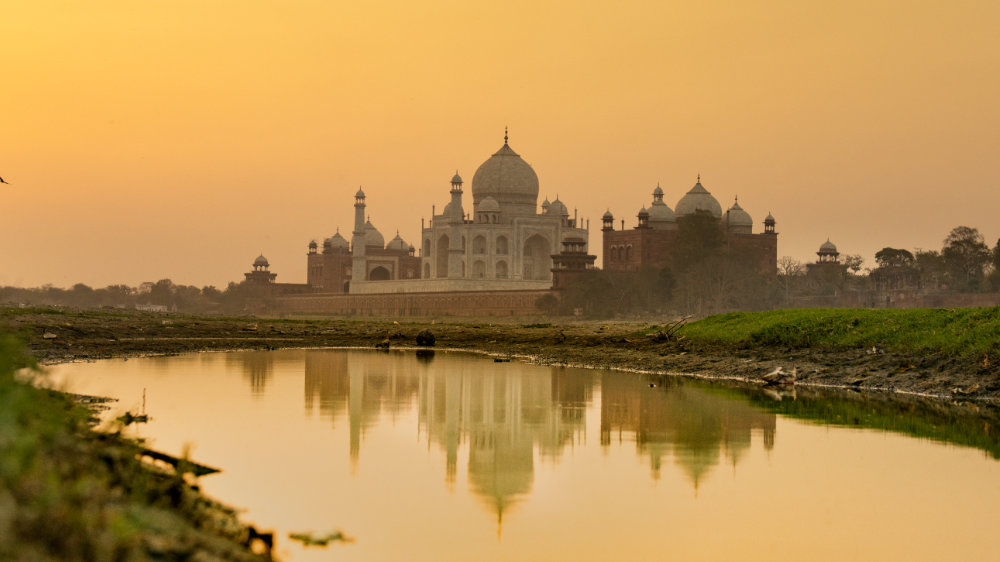
Most people who visit the Taj Mahal see it between 10 AM and 2 PM. They arrive after a long morning drive, queue at the entrance in the heat, walk through the gateway into a site already filling with thousands of other visitors, take their photographs from the designated spots, and leave feeling like they’ve seen one of the world’s great monuments.
And they have. The Taj Mahal is extraordinary at any hour. But here’s what those visitors don’t know — and what nobody tells you until you’ve experienced it yourself: the Taj Mahal at sunrise is a fundamentally different place. Not slightly better. Not marginally more photogenic. Genuinely, deeply different in a way that changes how the monument feels, what it means, and how long the memory of it stays with you.
This is the honest case for why seeing the Taj at sunrise is worth every bit of planning it takes to make it happen.

The Light Does Something Extraordinary
Photography enthusiasts talk about golden hour — that window just after sunrise when natural light is soft, warm, and comes in at a low angle that makes everything it touches look more beautiful than it actually is. The Taj Mahal in golden hour light is not just more photogenic. It is, genuinely, a more beautiful object.
The white marble of the Taj is not simply white. It is translucent. At different times of day, in different light conditions, it takes on different colours — pale blue in the pre-dawn darkness, a delicate blush pink as the sun first breaks the horizon, warm gold as the light strengthens, and eventually the flat, bleached white that most daytime photographs capture. Each of these is a different Taj Mahal. The sunrise versions are the ones that make people cry.
You cannot see this on a daytime visit. By the time most tourists arrive, the marble has already settled into its midday brightness and the magic of those early hours is simply gone until the following morning.
The Silence is Something You Feel
Here is the detail that surprises people most when they first visit at sunrise: the quiet.
The Taj Mahal receives roughly six to eight million visitors a year. On a busy afternoon, the site feels like it. Crowds move through the central pathway, cluster around the reflecting pool, gather at every photogenic angle. The noise of thousands of people — conversations, tour guides speaking over each other, the shuffle of feet on marble — becomes part of the backdrop whether you notice it or not.
At sunrise, almost none of that exists yet. You walk through the main gateway into a space that is very nearly empty. The sound of birds. The faint call to prayer from somewhere in the city beyond the walls. The occasional soft footstep of another early visitor who made the same choice you did. The Taj Mahal in this silence feels like it was built for exactly this moment — for standing in front of something almost impossibly beautiful and simply being present with it, without distraction or noise.
People who visit at sunrise consistently describe the experience as more emotional than they expected. The combination of the light, the quiet, and the scale of what you’re looking at creates a kind of stillness that the daytime version, for all its grandeur, simply cannot replicate.
You Actually Have Time to Look
There is a particular kind of tourist anxiety that affects busy heritage sites — the feeling that you need to move, keep pace with the crowd, not linger too long in any one spot because others are waiting. Daytime Taj visits can carry this feeling, especially during peak season.
Sunrise visits don’t. With fewer people and no sense of a crowd pushing through behind you, you can stand in front of the reflecting pool for as long as you want. You can walk around the perimeter of the mausoleum slowly, stopping wherever the view catches you. You can sit on the marble bench where the famous photographs are taken and actually be in the moment rather than hurrying to give way to the next person.
The Taj Mahal was designed to be absorbed, not rushed. The symmetry, the calligraphy, the inlay work of semi-precious stones in the marble — these are details that reward attention. A sunrise visit gives you the time to give them that attention.
Why This Requires Staying Overnight in Agra
Here is the practical reality: you cannot see the Taj Mahal at sunrise on a day trip from Delhi. The monument opens at sunrise, which during winter months is around 6:30 AM. Agra is three hours from Delhi. The mathematics simply don’t work.
To see the Taj at sunrise, you need to be in Agra the night before. And once you’ve committed to staying overnight, the entire trip transforms into something richer and more complete than any day trip can offer.
This is exactly what an Agra Overnight Tour is designed around. You arrive in Agra on the afternoon of day one, check into your hotel, and spend the remainder of the day visiting Agra Fort, the Baby Taj (Itmad-ud-Daula), and Mehtab Bagh — a peaceful garden across the Yamuna River that offers the most breathtaking sunset view of the Taj Mahal from the rear. You see the Taj from a distance as the sun goes down, glowing warm against the fading sky. Then you sleep in Agra, wake early, and walk into the monument as the sun rises over it.
Two entirely different versions of the same building, seen within twelve hours of each other. It is one of the most remarkable things travel can offer.
Fatehpur Sikri Makes Day Two Even Richer
The second day of an Overnight Agra Tour doesn’t end with the sunrise Taj visit. After breakfast and checkout, the itinerary continues to Fatehpur Sikri — Emperor Akbar’s abandoned red sandstone capital, about 40 kilometres from Agra.
Fatehpur Sikri is one of those places that feels genuinely undervisited relative to how extraordinary it is. Built in 1569 and abandoned within a generation due to water scarcity, the entire city is preserved almost exactly as Akbar left it. Walking through the Buland Darwaza — one of the tallest gateways in the world — into the mosque courtyard, or exploring the Diwan-i-Khas where Akbar held private audiences, you get a picture of Mughal imperial life that no museum exhibit can replicate.
An Agra Fatehpur Sikri Tour that combines the sunrise Taj experience with a proper Fatehpur Sikri visit covers more historical and architectural ground in two days than most travellers manage in a week of independent travel.
What Luxigo Tours Includes in Their Overnight Package
Luxigo Tours has built their Agra Overnight Tour Packages specifically around making this two-day experience seamless. Pickup from your hotel, airport, or any location in Delhi, Noida, Gurugram, or Faridabad. Private air-conditioned vehicle throughout. Professional English-speaking guides at every monument. Hotel accommodation with breakfast included (with 4-star and 5-star options available). And a drop-back to your chosen Delhi location after Fatehpur Sikri on day two — all starting from ₹11,996 per person.
The Agra Fatehpur Sikri Tour from Delhi with Luxigo Tours is entirely private — no shared vehicles, no group schedules, no waiting for other passengers. The itinerary moves at your pace, which on a two-day trip makes an enormous difference to how rested and present you feel at each site.
The One Decision That Changes Everything
Most travellers who visit the Taj Mahal on a day trip come away impressed. Most travellers who see it at sunrise on an Overnight Agra Tour By Car come away changed.
That’s not an exaggeration — it’s the consistent, unprompted feedback from people who’ve done both. The sunrise version is quieter, more beautiful, more emotionally resonant, and far more memorable. And it’s available to anyone willing to stay one extra night in Agra.
If you’re planning a trip to northern India and the Taj Mahal is on your list — which it should be — don’t settle for seeing it at its busiest and brightest. Book an overnight stay, wake up early, and walk through that gateway as the sky turns pink behind the dome.
You’ll understand immediately why no photograph has ever quite captured what it looks like.
Frequently Asked Questions (FAQs)
Q1. What time does the Taj Mahal open and when exactly is sunrise there?
The Taj Mahal opens at sunrise every day except Friday, when it is closed. Sunrise in Agra varies by season — it’s around 6:30 AM in winter (November to February) and as early as 5:30 AM in summer. Your guide on an Agra Overnight Tour will plan the morning pickup time based on the actual sunrise on your travel date, ensuring you arrive at the monument as it opens.
Q2. Is the Taj Mahal less crowded at sunrise compared to later in the day?
Significantly. The majority of visitors — particularly those on day trips from Delhi — arrive between 9:00 AM and 1:00 PM. Sunrise visitors are a small fraction of the daily total. You’ll share the site with far fewer people, have unobstructed views of the reflecting pool, and be able to move through the monument at your own pace without the crowd pressure that builds through the morning.
Q3. Can I see the Taj Mahal at sunrise on a day trip from Delhi?
No. The Taj Mahal opens at sunrise, and Agra is a three-hour drive from Delhi. The only way to see it at sunrise is to be in Agra the night before, which is exactly what the Overnight Agra Tour By Car with Luxigo Tours is designed for.
Q4. What else is covered in Luxigo Tours’ Agra Overnight Tour?
Day one covers Agra Fort, the Baby Taj (Itmad-ud-Daula), and Mehtab Bagh for the sunset view of the Taj across the Yamuna River. Day two begins with the sunrise Taj Mahal visit, followed by breakfast and checkout, then continues to Fatehpur Sikri before the return drive to Delhi. The full Agra Fatehpur Sikri Tour from Delhi covers five major sites across two days, starting from ₹11,996 per person.
Q5. What hotel options are available for the overnight stay in Agra?
Luxigo Tours offers 4-star and 5-star hotel options in Agra as part of their Agra Overnight Tour Packages. Breakfast is included with both options. The specific hotel can be confirmed at the time of booking based on your preference and travel dates.
Q6. How far in advance should I book the overnight tour?
At least 48 to 72 hours in advance is recommended, and further ahead during peak season between October and February when both hotel availability and tour slots fill quickly. Luxigo Tours can be reached directly via WhatsApp for booking, availability checks, and any customisation requests.