

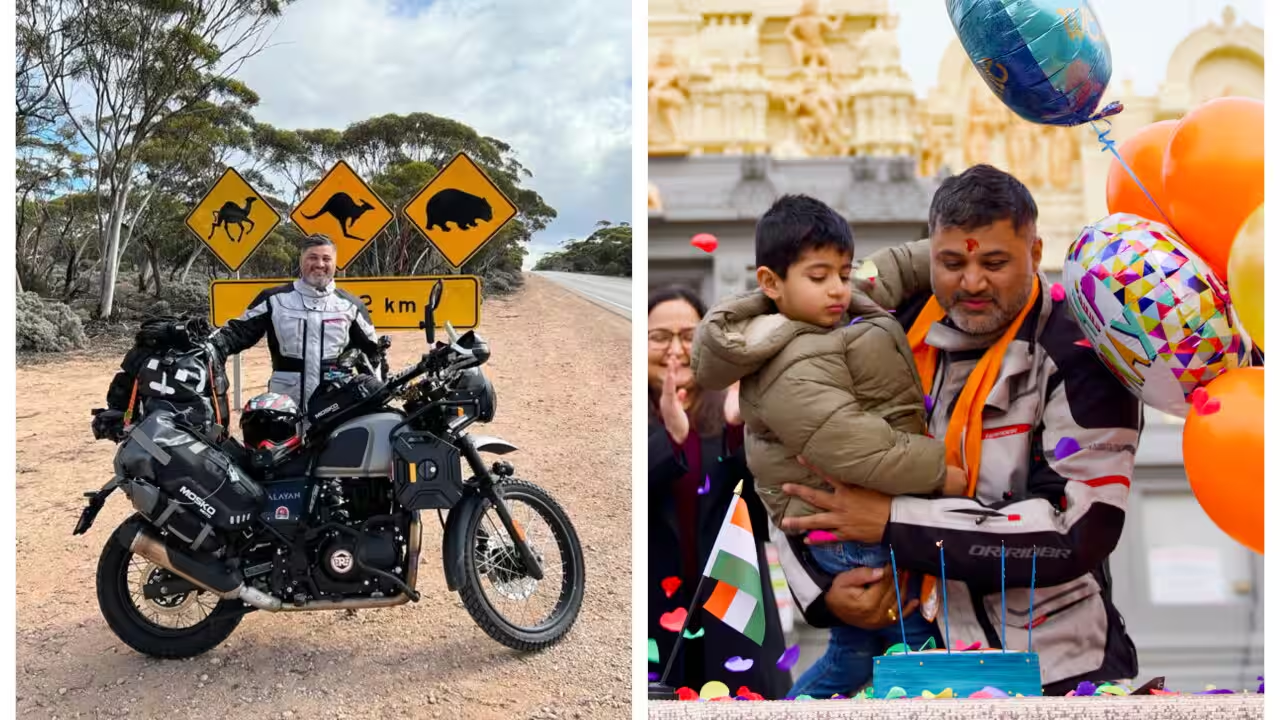
British motorcycle travellers Simon and Lisa Thomas crossed Australia diagonally, covering more than 4,830 km (3,000 miles) from the town of Mackay on the east coast to Perth on the west. Their route followed The Outback Way, known as ‘the world’s longest shortcut’. The official section of this track stretches 2,700 km (1,677 miles) from Winton to Laverton, but the Thomases extended the geography considerably, starting at the Coral Sea and finishing at the Indian Ocean. Temperatures exceeding 50°C, sand, gravel, scarce fuel stops and constant encounters with wildlife turned the journey into one of the most gruelling tests of their long careers.
The morning of departure smelled of salt and petrol. At the fuel station in Mackay the surf was loud, boats were heading out toward the Great Barrier Reef, and a $250-per-person tour remained well outside the budget. A very different Australia lay ahead.
Kangaroos, Gravel and First Blood
Already on the Peak Downs Highway, six large kangaroos leapt across the road simultaneously, directly in front of the motorcycles. A large male cast a wary glance and vanished into the tall grass. That episode set the tone for the entire journey.

In Clermont the travellers topped up their water supplies at an old general store where a battered 1950s Coca-Cola refrigerator was packed with bottles. A truck driver named Jim at the entrance, on hearing the couple’s plans, offered a brief and pointed warning: “This place wants to kill you. Watch out for the kangaroos.” His words proved prophetic.
West of Clermont the tarmac ended without warning. What followed was “glass” gravel — like millions of shiny ball bearings. On one dusty stretch Lisa’s motorcycle slid sideways, threw a highside and went down, pinning her beneath it. Fuel poured from a damaged fuel line, flooding her helmet, goggles and eyes. Lisa freed herself, rinsed her eyes with the water they had bought, while Simon straightened the bent gear shift lever and secured the broken hand guard with a cable tie. Fifty minutes later the pair were riding west again, patched up and fully aware that things would only get harder from here.
That evening near the tiny settlement of Alpha, the embers of a campfire glowed red while above them spread one of the most brilliant night skies either could remember. The Outback punished and rewarded in equal measure.
Winton, Boulia and 51 Litres of Water Between Two
The ride to Winton along the battered Landsborough Highway became a race against three patches on the rear tyre. A local mechanic named Steve tracked down a used but serviceable Conti TKC 80. During two days of rest the Thomases learned that Winton was the birthplace of both the folk song Waltzing Matilda and the airline Qantas. An exception was made for Lisa in the men’s bar of the Tattersalls Hotel.
Further on, along the Kennedy Development Road, a chain of 12 kangaroos struck by a road train was a shocking sight. In Boulia, topping up to the brim cost £155, and their water supply came to 51 litres. On the Donohue Highway the thermometer read 50°C. The motorcycles wallowed in soft sand, and dehydration set in faster than they could drink. At camp that night a three-metre snake crawled toward the site and had to be driven off with a stick. Camp behaviour changed instantly.
The Plenty Highway and a Blind Pass in the Dust
The Plenty Highway is listed in guidebooks as “four-wheel-drive vehicles only.” The surface shifted between rocky terrain, bulldust — ultra-fine red dust — and compacted dirt. Over three days only two vehicles came the other way, but one of them, a truck, left a dense cloud through which the riders travelled blind for around twenty seconds. The longest stretch without a fuel sign was roughly 450 km (280 miles), and the cost of refuelling reached £129.
The Northern Territory, Australia’s third-largest territory at 520,902 square miles, holds the country’s most iconic landmarks, among them Alice Springs, Uluru and Kata Tjuta.
Uluru, a Rainbow Over the Desert and the Finish at the Ocean
After three days of rest in Alice Springs — where the thermometer hit a record 53.3°C and a drought had lasted 157 days — the Thomases turned toward Rainbow Valley. Beyond a heavy sandy approach track, multi-coloured rock walls opened up in shades of ochre, orange and purple, and then the sky delivered an unexpected downpour complete with a rainbow and lightning.
The centrepiece was Uluru, rising 348 m (1,141 feet) above the flat desert. The monolith stretches 3.5 km in length and 1.9 km in width. Two days of walking around the UNESCO World Heritage Site, ancient rock paintings and a sense of the sacred that Aboriginal people have maintained for more than 10,000 years. The neighbouring domes of Kata Tjuta — 36 giant rock formations — deepened the feeling of being a grain of sand passing through time.
The final camp in the Outback, near Malcolm Dam Nature Reserve, brought a cool breeze, a family of pelicans and a sky that served as the journey’s closing note. Perth lay just ahead.
What You Need to Know Before Heading into the Outback
The practical side of the route comes down to several key factors.
- Documents. UK citizens require an ETA (Electronic Travel Authority) (£15, applied for online). Stays longer than three months require a visa. Travelling through Aboriginal lands requires separate permits.
- Motorcycle. A carnet de passage is required, along with a strict quarantine inspection on arrival. Shipping a bike such as the BMW R 1200 GS from London to Brisbane via Moto Freight costs approximately £880.
- Money. In the Outback, cash is king. Many roadhouses have no ATMs and do not accept cards. 1 AUD ≈ £0.55.
- Fuel and water. In towns petrol costs around £1.30/litre; in remote areas up to £2/litre. Carrying water reserves of tens of litres is a matter of survival.
- Accommodation. Roadhouses offering rooms (£76–£114), food (£11–£15) and camping (£19) are few and far between. Bush camping is possible but demands caution because of venomous snakes, spiders and crocodiles.
- Season. The optimal window for the Outback — the Australian winter — runs from June to August. The Dry lasts roughly from April to September; The Wet covers October through March.
- Roads. Traffic drives on the left. Outside populated areas the surface gives way to dirt, gravel and sand. Reducing tyre pressure on sand, exercising extreme caution in bulldust and in dust clouds thrown up by road trains, and constantly tracking the distances between water and fuel stops form the minimum survival skill set on this route.
Connectivity and battery life matter just as much. In the Australian Outback, mobile coverage is patchy or absent, so a phone is not a reliable way to call for help. Every member of the group should still carry a charged device, ideally with SIM cards from different carriers, since Telstra, Optus and Vodafone coverage varies enormously beyond city limits. Beyond that, treat satellite gear as essential backup: a two-way satellite communicator such as a Garmin inReach can send SOS messages and check-in texts with no mobile signal at all, and satellite internet such as Starlink can restore data and voice where the dish has a clear view of the sky. Keep both charged and know how to use them before you leave the bitumen.
The gaps between power outlets are measured in hundreds of kilometres, making a power bank of at least 20,000 mAh effectively essential. It is equally important to disable or delete all power-hungry mobile phone apps before setting off: navigation apps in constant map-download mode, streaming services, social networks with auto-play video and online casino apps. The latter are particularly popular among Australians, many of whom download them for various no-deposit bonuses, giveaways and other promotions. Even when minimised, however, such apps maintain background activity: push notifications, data synchronisation and geolocation can drain up to 15–20% of battery charge overnight.
On a route where the next power source may be 450 km away, that is a luxury you cannot afford. In the Outback, a phone must serve one purpose: keeping you connected to the outside world.